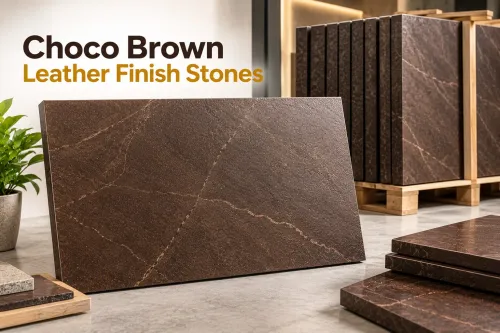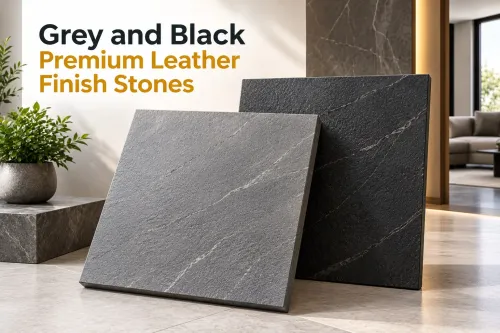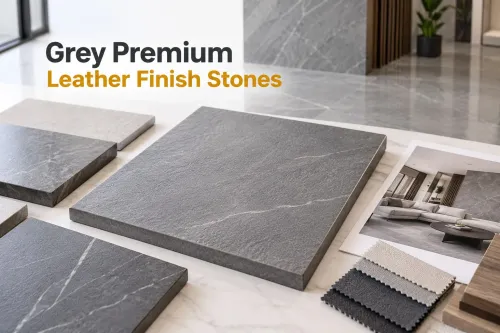
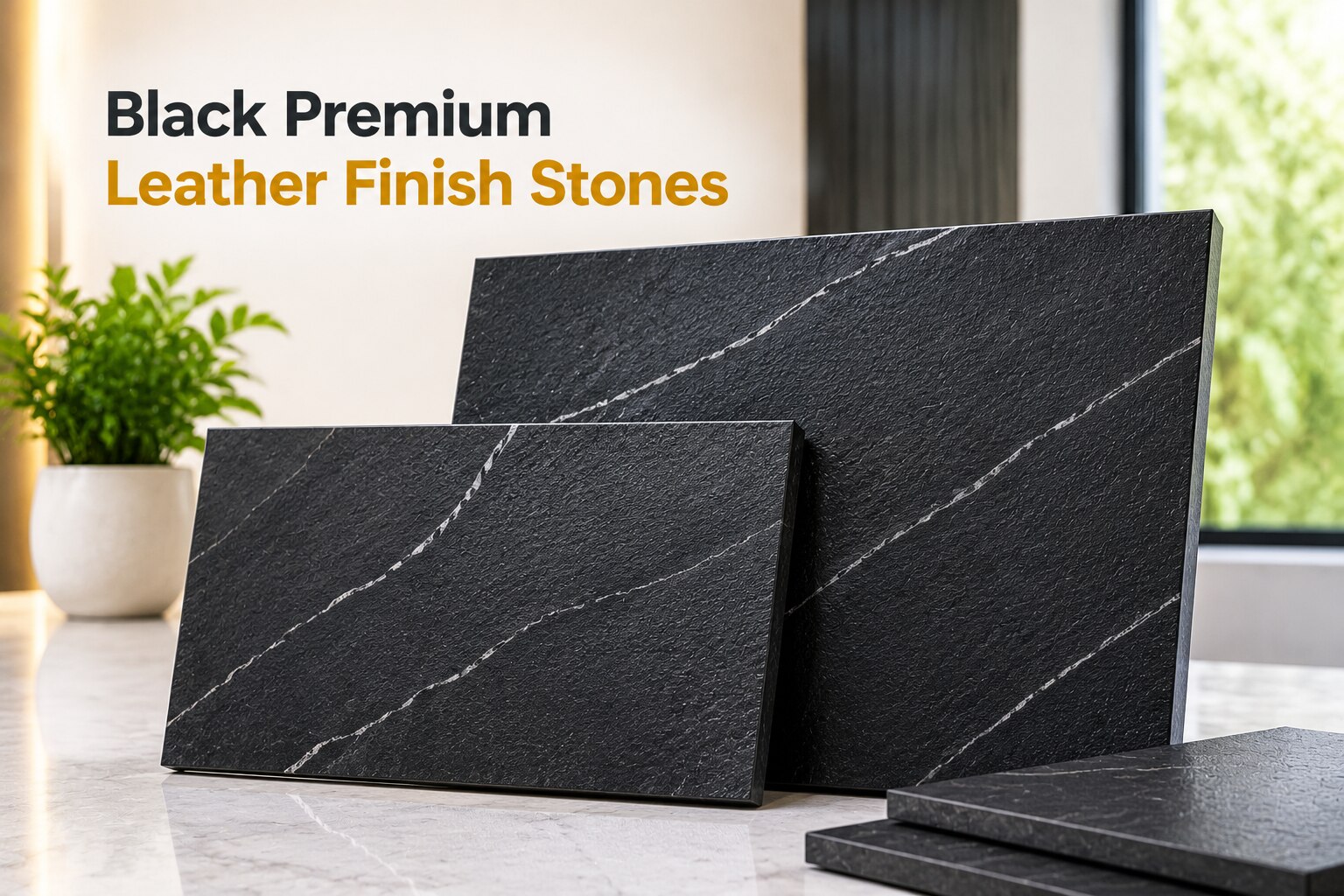
A black textured stone can look uniform in a showroom and reveal grey undertones, mineral veins, cloudy patches, or batch differences after installation. You will learn how to define the material, detect colour risks, approve a representative sample, test its response to sealing and cleaning, and specify a bulk order that can be checked on delivery.
Key takeaways
- Request the stone name, quarry origin, and petrographic identification.
- Inspect dry, wet, polished, and sealed samples before approving colour.
- Put sample limits, replacement terms, and inspection steps in the purchase order.
- Test cleaners and sealers on spare stone before site-wide application.
What black leather finish stone actually describes
Black premium leather finish stones is a trade description, not a geological category or standardised quality grade. A leather-finished slab may be granite, gabbro, basalt, marble, limestone, or slate. Request the commercial stone name, quarry or country of origin, and petrographic identification or clearly identified quarry material.
Leathering uses abrasive brushing, often after sawing and honing, to create an undulating, low-sheen surface. Brush pressure, abrasive sequence, and mineral grain can change the appearance from slab to slab.
| Surface | What it means |
|---|---|
| Honed | Flat, matte surface |
| Brushed | Lighter, softer, or more aged texture |
| Flamed | Heat-roughened surface, mainly for suitable silicate stones |
| Bush-hammered | Repeated impact points across the face |
| Sandblasted | Texture created by abrasive blasting |
| Naturally cleft slate | Split along geological planes, not mechanically brushed |
| Leathered | Brushed undulations with low sheen |
Supply commonly includes slabs and tiles, with stated nominal and minimum thicknesses. Confirm whether stock is calibrated, with controlled thickness, or uncalibrated, with greater variation. Colour can run from charcoal to near-black, with natural differences in grain, pits, veins, and sheen.
“Premium” has value only when measured through a documented inspection standard: tighter colour range, fewer open pores, even brush texture, calibrated thickness, sound edges, limited repairs, and acceptable flatness. Black colour alone proves neither low absorption, acid resistance, strength, nor slip performance.
How to catch colour problems before installation
Request dry and wet samples before approving any black premium leather finish stones supplier, then inspect at least two pieces together in north-facing daylight and under the project’s artificial lighting. A photograph can make slabs look uniform when they are not.
- Examine the face for grey or brown undertones, white mineral veins, yellow-orange rust marks, cloudy patches, edge-to-centre colour changes, open fissures, filled pits, brush-direction changes, and uneven sheen.
- Inspect the edges for colour changes, chipped repairs, waviness, and thickness differences; turn each piece over to check the back, resin, and mesh backing.
- Wet the face with clean water, let it dry completely, and record whether black becomes deeper, patchy, or lighter as moisture leaves.
- Approve full slabs or a representative panel showing tonal range, grain, repairs, brush direction, edge treatment, and appearance after cleaning. A small swatch can hide slab-scale variation.
- Compare that physical approval panel with the offered production lot, not merely a photograph. Record the quarry block, batch or production lot, slab numbers, finish, thickness, and date, then require confirmation that future deliveries will come from the same block or lot.
| Observation | Risk | Action |
|---|---|---|
| Grey or white haze after drying | Grout haze, efflorescence, hard-water deposits, or sealer residue will show strongly on black stone | Test cleaning and sealing in the intended environment |
| Yellow, orange, or brown marks after wetting | Iron-bearing minerals may oxidise where moisture and oxygen reach the stone | Request quarry-specific evidence before wet-area or exterior use |
| Different sheen or brush direction | Pieces may not match after fixing | Reject the mixed lot or obtain written approval before installation |
What a premium approval and replacement process should contain
Turn “premium” into a signed purchase specification before requesting quotations for black premium leather finish stones bulk. The supplier must identify the actual material and lot, not rely on a sales label.
1. Record the stone species or commercial name, quarry origin, slab or tile format, nominal and minimum thickness, calibrated status, leathering process, permitted colour and texture variation, edge finish, flatness tolerance, resin repairs, mesh backing, visible fissures, and packing method.
2. Require reports for the offered lot covering water absorption, apparent density, flexural strength, abrasion performance, and the project’s slip-resistance test for the finished leather surface. Reject a generic report for another black stone or for polished material.
Texture does not prevent scratches; its valleys can hold grout pigment, cement slurry, cutting dust, and oily fingerprints.
3. Approve a physical mock-up showing cutting, edge profiling, joint filling, cleaning, and the intended lighting. For exterior or wet-area use, ask for evidence from repeated saturation-and-drying exposure and written proof supporting any rust-free claim.
4. Before unloading, photograph every lot and retain a labelled control sample. Compare it with the approved sample for colour, thickness, finish, repairs, and damage.
Write the remedy into the order: the supplier replaces slabs or tiles outside the approved limits. State the inspection deadline, required photographs and lot records, freight responsibility, and the remedy for mixed-lot delivery, such as replacement of the complete affected lot rather than isolated pieces.
How sealing and cleaning change the apparent black colour
An impregnating sealer reduces penetration by staining liquids; it does not make stone stain-proof, waterproof, or maintenance-free. A colour-enhancing impregnating sealer can deepen black stone and emphasise cloudy areas, veins, and brush valleys.
Confirm the stone type before choosing one. Test the exact sealer and coat count on an offcut or mock-up, with one marked untreated control area.
| Treatment | What you may see | Comparison point |
|---|---|---|
| Enhancing impregnating sealer | Deeper black, stronger veins and cloudy patches | Compare immediately and after the stated cure time |
| Untreated control | Original dry colour and sheen | Keep beside the treated area |
| Wetted test area | Temporary darkening or patchiness | Wet and dry both areas before approval |
Install first, then allow adhesive and grout moisture to leave according to the stone, adhesive, grout, and sealer manufacturers’ instructions. Do not choose a fixed waiting period without those instructions; record substrate moisture and the test result. Seal only a clean, dry surface.
For routine cleaning, use clean water and a pH-neutral stone cleaner, approximately pH 6 to 8, with a soft brush or non-abrasive pad. Avoid vinegar, lemon, hydrochloric acid, sulphamic acid, abrasive powders, bleach mixtures, and strong alkaline degreasers until the chemistry is confirmed; acids can etch limestone and marble.
Remove cement haze with an identified, stone-safe product; treat hard-water deposits on carbonate stone with a compatible non-acid method. Use an alkaline stone poultice or approved degreaser for oil, and blot, rinse, then poultice beverage stains.
Budget more labour than for honed stone because textured valleys retain residue, especially on black premium leather finish stones india projects.
How to specify a reliable black stone bulk order in India
A quotation for black premium leather finish stones bulk is comparable only after you identify the actual material, lot, and delivered cost. Treat “premium” as a specification, not a grade: require colour limits, texture consistency, thickness tolerance, and inspection evidence.
| Source | Record separately | Compare |
|---|---|---|
| Domestic material | Quarry, processing location, available formats, lead time, GST basis, and freight from the yard | Indian origin and actual dispatch point |
| Imported stock through an Indian distributor | Country of origin, Indian processing location, port or warehouse, import tax basis, freight, and replacement route | Longer replenishment time and lot availability |
Send every black premium leather finish stones supplier this checklist:
- Stone species or commercial name; quarry or country of origin; processing location; slab or tile dimensions; nominal and minimum thickness; calibrated or uncalibrated status.
- Leathering process, acceptable colour and texture variation, edge treatment, resin repairs, and resin or mesh backing.
- Packing requirements, delivery lot or retained batch number, lead time, breakage replacement policy, tax basis, and freight basis.
- Water absorption, apparent density, flexural strength, abrasion, and project-specific slip test reports for the offered lot, not an unrelated sample.
Before paying for black premium leather finish stones India orders, request dry and wet approval pieces, inspect a full slab, retain the batch number, and obtain a written mismatch remedy.
For Telangana sourcing, evaluate Agarwal Stone Company against this same checklist: identity, quarry or lot, thickness, finish consistency, inspection records, packing, and replacement terms. Choose traceable colour consistency over the lowest quotation; replacing mismatched slabs costs more than approving the lot properly.
Frequently asked questions
What does black leather finish stone describe?
It describes a textured surface finish and dark appearance, not a geological category or standardised quality grade. The slab may be granite, gabbro, basalt, marble, limestone, or slate.
How can you catch colour problems before installation?
Request representative slabs or tiles and inspect them under the project lighting in dry, wet, and sealed conditions. Compare variation across multiple pieces, check for pale patches and resin-filled areas, and record approved samples with photographs.
What should a premium approval and replacement process contain?
The order should identify the approved sample, acceptable colour and texture variation, inspection timing, rejection procedure, replacement responsibility, and the remedy for mismatched or damaged material.
How do sealing and cleaning affect black stone colour?
A sealer can deepen or darken the stone, while uneven application can create patches. Acidic cleaners, abrasive powders, and unsuitable solvents can etch or dull the surface. Test every product on spare material first.
Keywords